Description
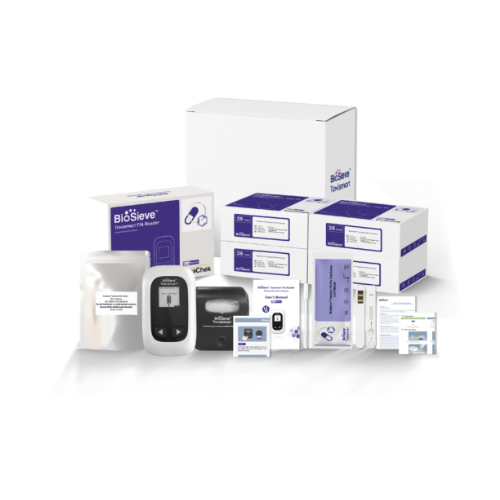
Contents: (1) BioSieve Toxismart Meter, (1) Blue Tooth Printer, SQC test and charging cables, (4) boxes of 25 count test strips, (1) Box Controls, Instructions
Regulatory Status: CLIA Waived / OTC Approved
Sample Type: Urine
Determinations: Fentanyl
Processing Time: 2 to 5 minutes,
Power Source: Rechargeable 3.7 Volt Lithium Ion battery
BioSieve™ ToxiSmart Reader is a portable fluorescence immunoassay (FIA) device designed for the rapid and accurate detection of fentanyl in human urine samples. Utilizing advanced fluorescence immunochromatography technology, it offers a high sensitivity with a cutoff concentration of 1.0 ng/mL
- Portability and Convenience: Weighing approximately 0.36 lbs (5.8 ounces), the ToxiSmart Reader is lightweight and easy to transport, making it suitable for both laboratory and point-of-care settings
- User-Friendly Design: Equipped with a handheld Bluetooth reader and a rechargeable lithium battery, the ToxiSmart Reader ensures ease of use and seamless integration into various testing environments
- Data Management: Capable of storing up to 999 test results, the device simplifies record-keeping and enhances data management efficiency
- FDA Approval: The BioSieve™ ToxiSmart Reader, in conjunction with the BioSieve™ Fentanyl FIA Home Test Kit, has received FDA approval for over-the-counter (OTC) use, marking a significant milestone in accessible fentanyl detection.
Resources: